Research
Working in biophysics, mathematical biology, systems biology, and theoretical immunology, I use mathematical modeling and data analysis to understand biological phenomena. The work draws on statistical mechanics, dynamical systems theory, information theory, learning theory, and ideas from self-organization and complex systems.
My published work so far falls mainly under the three themes below. I am also working on other themes.
- How cells process information (self/nonself discrimination by immune cells)
- How mitochondria are positioned in cells
- Predicting disease course and treatment response
The way I think about research is described in Background at the end of this page.
How cells process information
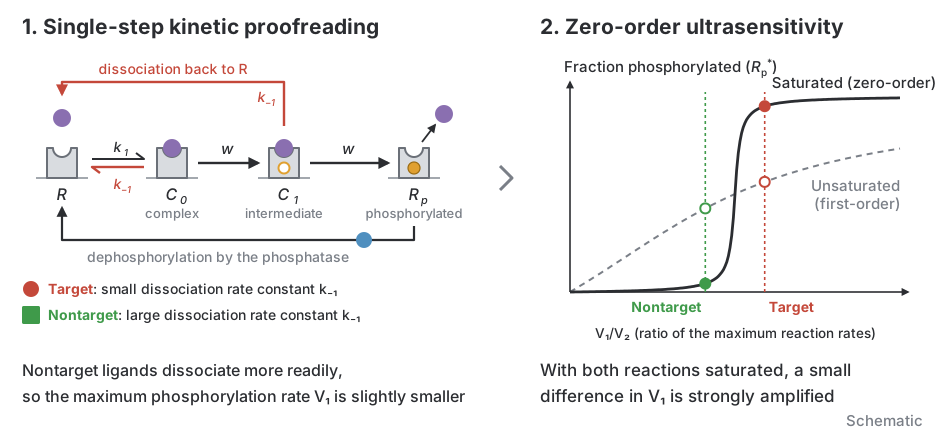
T cells distinguish self from nonself molecules by small differences in binding strength. This discrimination is often explained by kinetic proofreading (Hopfield 1974; Ninio 1975; for T cells, McKeithan 1995), in which a multistep reaction lets weakly bound molecules drop off before signaling. More steps make discrimination more accurate, but responses slower and weaker. We combined two well-known nonlinear mechanisms, kinetic proofreading and zero-order ultrasensitivity arising from saturated enzymatic reactions (Goldbeter and Koshland 1981), as parts of a network: the former converts differences in binding strength into a difference in the rate of receptor phosphorylation, and when both phosphorylation and dephosphorylation are saturated, that difference is amplified sharply (zero-order ultraspecificity). With this mechanism, even a single proofreading step lets a small amount of target be detected with high sensitivity and discriminated with high specificity, and the response is also fast. We further showed that extending the model adds insensitivity to large amounts of nontarget molecules (Phys. Rev. E 2017).
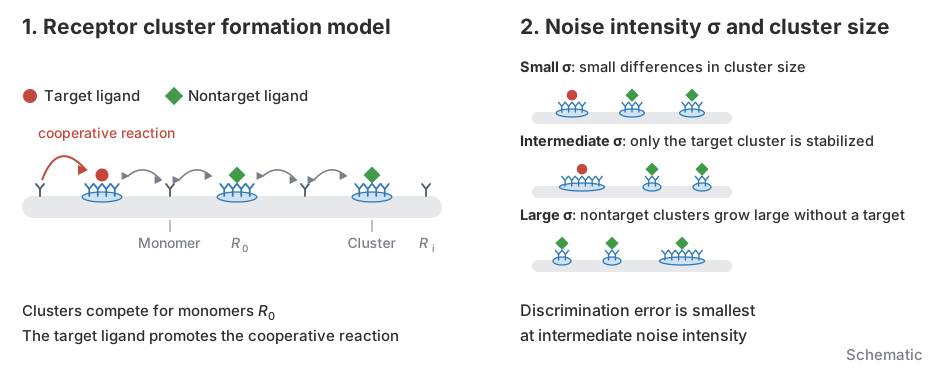
When T cells are activated, receptors bound to ligands gather into clusters on the cell surface. We studied a stochastic model in which each ligand induces a cluster and the clusters compete for a limited number of receptors (Chaos 2020). A cell is taken to recognize a ligand as the target when the cluster of that ligand becomes sufficiently large. The target ligand only slightly promotes the cooperative reaction by which a cluster takes up receptors.
Reactions inside cells fluctuate randomly because few molecules are involved, and such noise is generally thought to reduce the accuracy of information processing. In this model, however, noise made the target easier to discriminate. With weak noise, all clusters stay at about the same size; the target cluster is only slightly larger, so the target cannot be told apart from nontargets. With moderately strong noise, states appear in which a single cluster takes up most of the receptors (noise-induced symmetry breaking). Only the target cluster then stays large and stable, so the slight difference of the target becomes a large one, and the target is detected with high sensitivity and specificity. With too much noise, nontarget clusters also become large by chance, and errors increase. Detection errors were therefore smallest at an intermediate noise intensity (intermediate σ in the figure below).
Even with many nontarget ligands, detection accuracy hardly fell as long as the noise intensity was appropriate. Because the nontarget clusters compete with one another for receptors, false responses to nontargets decrease; the resulting increase in missed targets can be offset by stronger noise.
Related: Phys. Rev. E (2017), Chaos (2020), Seisan Kenkyu (2019), Biophysics (2015).
How mitochondria are positioned in cells
In neurons of the central nervous system, stationary mitochondria are distributed relatively uniformly along unmyelinated, nonsynaptic axons. Experiments by our collaborators showed that the ATP:ADP ratio is relatively high around mitochondria. Locally inactivating mitochondria with light made nearby mitochondria move less, suggesting that functional mitochondria promote the movement of nearby mitochondria. A mathematical model in the same paper showed that the ATP gradient generated by mitochondria and ATP-dependent regulation of their motility can produce a uniform distribution (Mol. Cell. Neurosci. 2022).
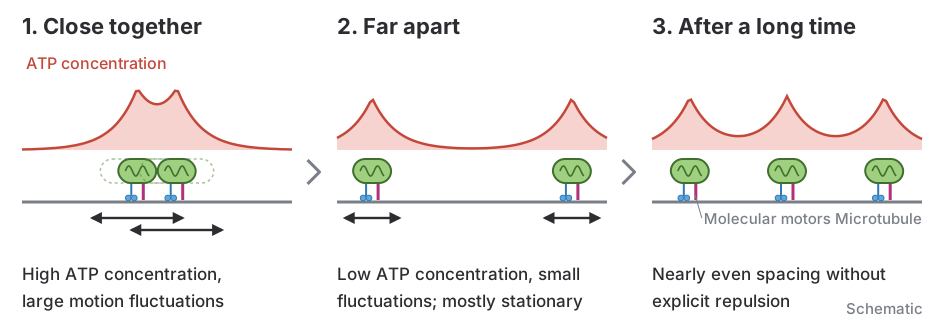
Using a theoretical model, we showed that ATP production by mitochondria and ATP-dependent, nondirectional fluctuations in their movement are sufficient for them to align at nearly equal intervals (Phys. Rev. Research 2024). The model assumes no direct interaction between mitochondria, and no internal state or memory of the mitochondria. Because mitochondria produce ATP, when two come close the local ATP concentration rises and their motion fluctuates more; when they are apart, ATP falls, the fluctuations shrink, and they tend to stay put. The result is an effective repulsion mediated by the ATP concentration. Because it can be viewed as a force similar to the thermodynamic forces driven by thermal fluctuations, but generated by energy-consuming nonequilibrium processes, we named it the active thermodynamic force. Work on this question continues under a JSPS KAKENHI Grant-in-Aid for Scientific Research (B).
Related: Phys. Rev. Research (2024), Mol. Cell. Neurosci. (2022). Press release
Predicting disease course and treatment response
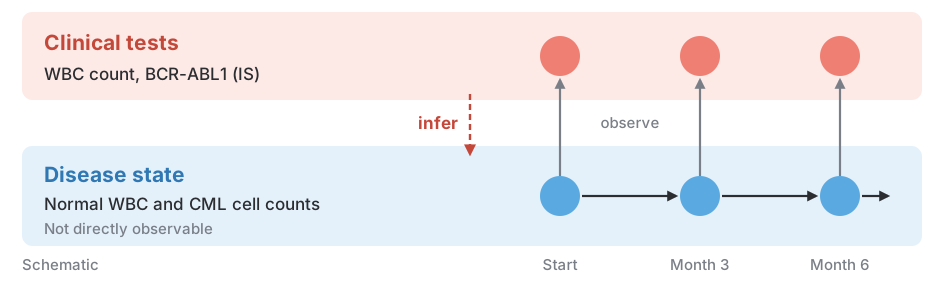
Clinical test values do not show the disease state itself; they reflect only part of it. We develop methods that infer the disease state, which cannot be observed directly, from time series of test values, and that predict the course of a disease and its response to treatment by estimating a mathematical model of how the disease state changes over time, together with its parameters.
Tyrosine kinase inhibitors have greatly improved the prognosis of chronic myeloid leukemia (CML), but their efficacy differs between patients. We used a simple dynamical model of the numbers of normal white blood cells and CML cells. These cell numbers cannot be measured directly, but parameters such as the reduction rate and the convergence value of CML cells can be estimated for each patient from the WBC count and BCR-ABL1 (IS) measured in routine clinical practice. The estimated parameters classified patients with different responses to nilotinib, and data from only three time points after the start of treatment identified, with high accuracy, patients who would not reach the treatment goal of deep molecular response (npj Syst. Biol. Appl. 2022). Because the model relies only on general properties of the response to these inhibitors, it may also apply to other inhibitors.
Related: npj Syst. Biol. Appl. (2022). Press release
Background
On the banks of the Kamo River in Kyoto, couples sitting along the river are known to space themselves at nearly equal intervals. Nobody arranges them. If the neighbors are too close, a couple feels a little uneasy and moves; where there is enough room, they settle. Each acts on its own, yet the whole row ends up evenly spaced.

As a student, I wondered how living things, which are only collections of molecules, can think and make decisions. While reading Shannon’s information theory and watching Ghost in the Shell, I imagined technologies like the cyberbrains in that story and became interested in how a single cell processes and stores information. In What Is Life?, Schrödinger argued that the laws of physics hold as averages over enormous numbers of atoms; with few atoms, fluctuations become large and precise laws no longer hold. Yet inside a cell, many kinds of molecules are present only in small numbers, and the cell still processes information accurately.
T cells, a type of immune cell, distinguish antigenic peptides that differ by a single amino acid, and respond quickly to very few of them. When I began my undergraduate research, I saw fluorescence microscopy images and movies of T cell receptors forming small clusters (microclusters) on the cell surface during activation, and I wondered whether these clusters help the cell process information. At the time, I asked how cells suppress fluctuations to keep this accuracy. But when I studied models in which the size of the fluctuations depends on the state of the system, I found that the fluctuations can instead improve discrimination.
I think something similar happens to mitochondria in neurons. Mitochondria produce ATP, and in our model they move with larger fluctuations where ATP is high. Then, near other mitochondria they keep moving, and away from them they tend to stay in place. As a result, although they do not push each other, they line up at nearly equal intervals along the axon, much like the couples on the Kamo River.
Cells work at scales where fluctuations cannot be ignored, as Schrödinger pointed out: the so-called mesoscopic regime. In engineering, noise is something to be removed as far as possible; to build a precise machine, you want parts that do not fluctuate. Yet life, for some reason, works in this regime, and works well. If so, perhaps living systems do not merely suppress fluctuations but also make use of them somewhere. What I find interesting is that such mechanisms run against human intuition.
Why am I drawn to particular phenomena and problems, and want to understand them, without anyone telling me to? Questions that many people are studying do not bother me much, because I can eventually learn the answers from their work. Questions nobody has touched stay unanswered unless I look into them myself, so they keep my attention and I stay with them. Like the couples on the Kamo River, who move away when a neighbor is too close and stay where there is room, although I believe I have chosen the puzzling phenomena I study of my own will, I have probably just been pushed into the empty spaces by an effective repulsion from other researchers.
Perhaps the objects of researchers’ curiosity, too, are spaced apart in this way. I thought I was simply choosing whichever problem caught my attention at the time, yet looking back, the problems I chose are more connected than I expected. When the traces of discoveries born of researchers’ curiosity, mine included, are later viewed as a whole, what order or patterns will appear in the space of knowledge? Science and scholarship, too, take an orderly form even though nobody designed the whole; in that sense they may resemble the evenly spaced couples on the Kamo River.