How cells process information
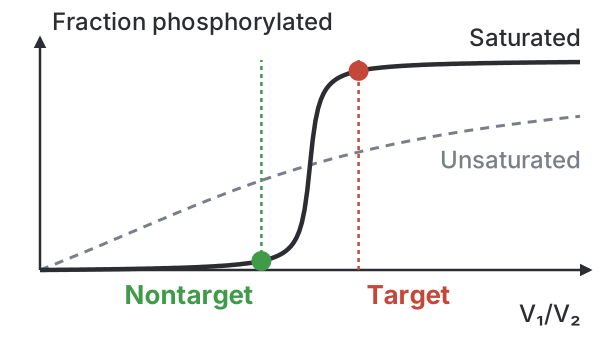
How immune cells distinguish molecules of very similar structure, studied as statistical information processing.
I am Masashi K. Kajita, a senior assistant professor in the Department of Applied Chemistry and Biotechnology, Faculty of Engineering, University of Fukui. I work on problems in biophysics, mathematical biology, systems biology, and theoretical immunology, using mathematical models and data analysis.
How immune cells distinguish molecules of very similar structure, studied as statistical information processing.
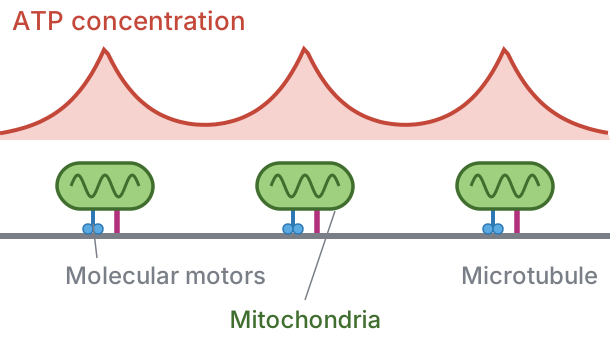
Why mitochondria are spaced nearly evenly along neuronal axons, explained by fluctuations in motion that depend on the ATP concentration.
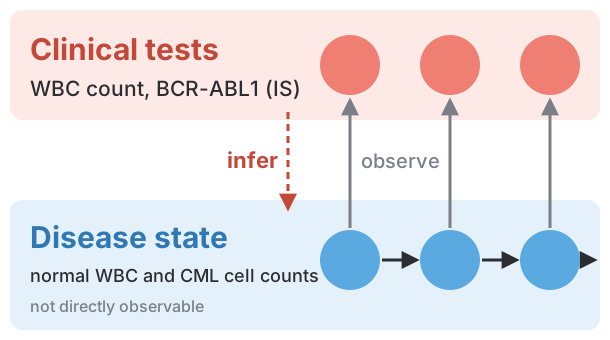
Using mathematical models to infer the disease state, which cannot be observed directly, from time series of routine clinical tests, and to predict treatment response early.
See Research for details and Publications for papers.
We showed theoretically how mitochondria come to be spaced nearly evenly along neuronal axons. Because mitochondria produce ATP, two that come close raise the local ATP level and fluctuate more, while those apart tend to stay put; as a result they line up at nearly equal intervals without any direct interaction (Phys. Rev. Research 2024).
For supervision and how research is done in the group, see Join us.